Business
Does Your Business Need a Website in 2026, or Are Instagram and WhatsApp Enough?
Manal ElhaririLast updated: 10 min read
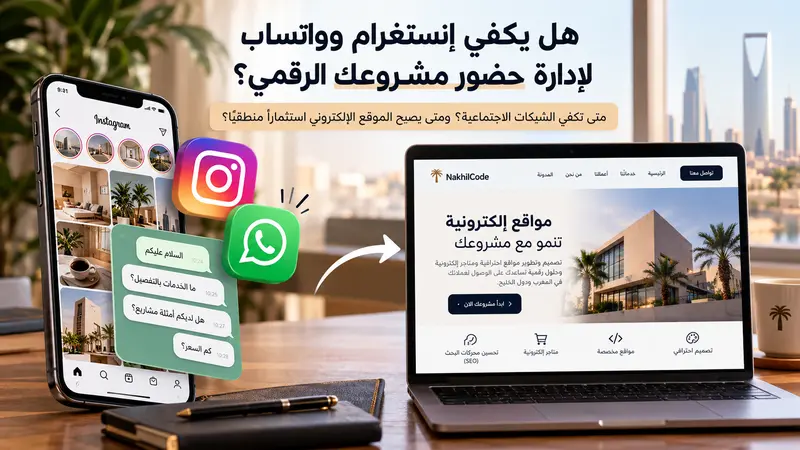
A potential customer finds your business on Instagram, likes the work, and wants the full picture: services, examples, pricing approach, and how to request a quote. The conversation then splits across DMs, comments, Stories, and WhatsApp — and sometimes ends before the offer is clear.
That does not mean every business loses customers without a website. Many grow through social media and personal referrals. The sharper question in 2026 is: when are Instagram and WhatsApp enough, and when does a website become a practical reference worth investing in?
This guide is for small and mid-sized businesses in Saudi Arabia, Kuwait, the UAE, and the wider GCC. The goal is a fair decision — not pressure to buy a site at any cost.
In the Gulf especially, customers move quickly between mobile discovery, private chat, and internal discussion with a partner or manager. Each extra hop without a stable reference increases the chance of delay — even when your delivery quality is strong. So ask a clearer question: do your current channels explain your offer well enough for how your buyers decide? If yes for most leads, you may not need a complex site yet. If not, a website is an organizational option worth evaluating.
What a website actually adds to your business
A good website does not create automatic trust by existing. It gives you a space you control:
- Organize services or products on clear pages.
- Present past work in a form people can revisit.
- Provide one shareable destination for your bio, ads, email, and WhatsApp replies.
- Explain how to contact you or request a quote without repeating the same answers.
- Create a technical foundation for relevant search visibility — knowing that visibility needs useful content and consistency, not a publish button alone. See also Why your website does not appear on Google.
Operationally, a site can standardize the wording your team uses, connect campaign links to a clear landing point, and keep an up-to-date service description without digging through old chats. Those benefits are easy to miss when you only compare cost to “one more post.”
In short: a website adds structure, a durable reference, and shareability. Commercial results still depend on offer quality, response speed, and the value you deliver. A vague site with weak mobile usability can hurt more than it helps.
Website vs Instagram vs WhatsApp: a practical comparison
This table compares roles — not a ranking of “best tool forever”:
| Dimension | Website | ||
|---|---|---|---|
| Main purpose | Organized offer reference | Discovery and visual content | Direct conversation |
| Content organization | Stable pages and clear links | Feed and Stories that change | Scattered threads |
| Customer discovery | Search, referrals, shared links | Social exploration and engagement | Saved number or direct link |
| Search engine visibility | Possible with solid content and technical basics | Limited versus websites | Not built for public search |
| Control of presentation | High (your design and structure) | Within platform rules | Within chat UI |
| Direct communication | Forms, WhatsApp buttons, links | DMs and comments | Very strong |
| Long-term access to information | Strong if maintained | Fades as the feed moves | Depends on chat history |
| Maintenance | Content updates and hosting | Regular publishing | Time to reply and follow up |
The three tools complement each other: Instagram opens the door, WhatsApp continues the dialogue, and a website helps people who need depth before they decide.
When a website becomes a logical investment
Consider a website when signals like these keep appearing:
- Repeated questions about services, scope, and pricing approach.
- Multiple product or service categories that do not fit one post.
- A growing portfolio that needs structure.
- A need for clearer quote requests instead of only casual chat.
- Business buyers who research suppliers before contacting you.
- A goal to appear for relevant search queries over time.
- Work across multiple cities or GCC markets.
Another signal: corporate or institutional buyers ask for a link “to show management.” A strong Instagram profile may still feel incomplete for that review step. A shareable services page reduces friction in approval cycles.
If you rewrite the same explanation every day, a website can save time before serious selling starts. To avoid common post-launch issues, read 10 mistakes that kill your website.
Illustrative GCC scenarios
The following examples are hypothetical for illustration. They are not real clients and not documented results.
1) A finishing or contracting company in Saudi Arabia
Instagram shows completed sites. WhatsApp receives inquiries. A simple website can gather service scope, process steps, a categorized project gallery, and a site-visit request form — so an engineer shares one page instead of re-explaining everything in each chat.
2) A service company in Kuwait
Think maintenance, home services, or consulting. Social channels create attention, while a services page with coverage areas, response expectations, and a WhatsApp button helps visitors decide whether to message at all.
3) A furniture or décor business in the UAE
Visual content on Instagram is essential. As the catalog grows, a website or online catalog helps people filter by room or style, while WhatsApp remains the fast order channel.
4) A restaurant or café relying on menu photos in WhatsApp
Social channels drive discovery, but a structured price list during table service usually needs a clearer interface than scattered PDF images. For a real project in that direction, see the One Chickens digital menu case study.
Does a website alone bring customers?
No. Launching a website does not guarantee traffic, inquiries, or sales. Separate these pieces:
- Having a website: a technical and reference foundation.
- Search engine optimization: content, structure, and quality signals over time.
- Content quality: clear answers to real buyer questions.
- Advertising: paid reach when needed.
- Social media: discovery and relationship.
- Customer experience: response speed and keeping promises.
- Conversion: an obvious next step (call, WhatsApp, form).
A common mistake is judging a site after one week by traffic alone. Visits without inquiries may mean a weak offer page or weak traffic source. Inquiries without much site traffic may mean social is still your strongest channel — which is fine if deals close. Watch the full path: discovery, understanding, contact, then close.
A website is one part of the system. Published without clear content and follow-up, it will not fix a weak offer or slow communication.
How to start with the right site — without paying for features you do not need
Choose the shape based on real requirements:
- Landing page: one offer or campaign with a clear contact goal.
- Business website: several pages (services, work, about, contact).
- Product catalog: browse and organize without necessarily full checkout.
- E-commerce store: when cart and online payment are core to the model.
Before you sign any proposal, answer this: what is the first page a customer should open after tapping the link in your bio? If you cannot answer in one sentence, you are not ready to choose the site type yet. List top services, recurring questions, and a handful of real project photos — then pick the smallest format that serves that.
Start with what you need now and leave room to expand. Avoid paying for a complex dashboard or full store if WhatsApp still runs your orders. For a rough sense of website scopes, see our website cost guide, remembering that markets and currencies differ.
After launch, schedule a light monthly review of copy, numbers, WhatsApp links, and campaign URLs. An outdated site loses usefulness quickly — just as an inactive social account loses momentum.
Conclusion: website, Instagram, and WhatsApp work better together
Social platforms help people discover and contact your business. A website gives them an organized destination to understand the offer at their own pace. You do not have to treat them as opposites.
If Instagram and WhatsApp already explain your offer clearly and demand is simple, waiting can be sensible. If the same questions keep repeating, the offer is expanding, and sharing a stable link has become daily work, a website is an investment in clarity — not a magic sales switch.
Thinking about a website for your business? Contact NakhilCode for a free initial consultation and a preliminary website concept.
FAQ
Can my business succeed without a website?
Yes. Many businesses grow through referrals, Instagram, and WhatsApp. A website becomes useful when you need an organized reference, search visibility over time, or a clearer explanation than short chats can hold.
Is a website better than Instagram for business?
It is not a zero-sum choice. Instagram is stronger for visual discovery and engagement; a website is stronger for durable organization. Most businesses benefit from using both.
Will my website appear on Google right after publishing?
There is no guarantee of immediate appearance or any specific ranking. Indexing and visibility take time, clear pages, technical basics, and follow-up in tools such as Google Search Console.
Does a small business need an online store?
Not always. If orders run through WhatsApp and the catalog is small, a simple brochure site or catalog may be enough. A full store makes sense when cart and online payment are central to how you sell.
Can a website connect to WhatsApp?
Yes. A WhatsApp button or prefilled link is common, so the site explains the offer and WhatsApp handles the conversation.
What is the difference between a landing page and a multi-page website?
A landing page focuses on one offer and one contact goal. A multi-page site separates services, work, and contact into dedicated pages and suits broader offers.
Does a website replace Instagram ads?
No. A website does not replace paid reach or social content. It can improve what happens after someone clicks, but it does not create paid distribution by itself.
Related posts
SEO
Why Your Website Doesn't Appear on Google? 7 Professional Solutions 2026
Is your website missing from Google? Discover 7 professional reasons and proven solutions to boost your ranking with quality from NakhilCode.
Website quality
10 Fatal Mistakes That Kill Your Website | Professional Guide 2026
Discover 10 critical mistakes destroying your website with practical solutions from NakhilCode to improve your site with care.
Case study
Digital restaurant menu with admin dashboard: what restaurants actually need — One Chickens case study
One Chickens (واحد دجاج): responsive digital menu and admin dashboard, guest cart, and structured WhatsApp orders in IQD.
Are Instagram and WhatsApp enough for your digital presence?
Used well, Instagram and WhatsApp are genuinely effective:
They also have natural limits — not because they “fail,” but because they were not designed as a full business reference:
Instagram rewards visual consistency more than long documentation. That is excellent for a portfolio feed and weaker for explaining packages, process, or boundaries. WhatsApp is excellent when someone is ready to talk, but costly if it replaces a clear service page or FAQ.
Platform rules and algorithms also change. You do not need to fear that daily — but it is wise not to keep every critical business explanation only inside an app whose rules you do not control.
Bottom line: social channels are strong for discovery and conversation. They are not always the best place for a calm, complete explanation of your offer.